I wasn't even looking for a dresser. That's always how it starts.
It was a Tuesday night, Mia was finally asleep, and I was doing what I do most evenings: scrolling Facebook Marketplace with the vague excuse of "just checking." Derek was in the living room practicing a brass exercise on his trumpet. The dog was snoring. And there it was — a listing so bad it was almost good.
The photo was blurry. The dresser was shoved against a garage wall behind a bicycle. The description said: "Old dresser. $40. Works fine. Must pick up today."
Reader, I picked it up that night.
What $40 Bought Me
The dresser was solid wood. That's the first thing I check, and it's the only reason I drove twenty minutes to a stranger's garage at 8 p.m. If it had been particleboard with a wood veneer, I would have kept scrolling. You can refinish veneer, but it's a much more delicate operation, and I wanted something I could be aggressive with.
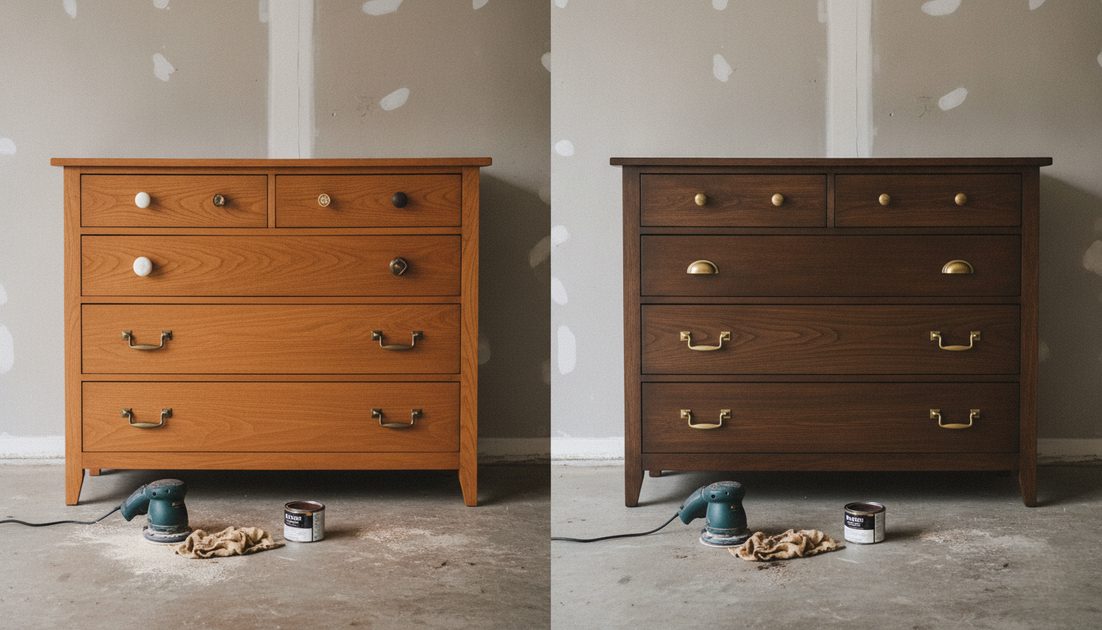
This piece was maple — heavy, sturdy, drawers that still slid even though they groaned a little. It smelled like a basement. Not a clean basement. The kind of basement where a previous owner stored paint cans and possibly a wet dog. Three of the six drawer pulls were original brass cup pulls. The other three were mismatched: one ceramic knob with a faded floral pattern, one brushed nickel bar pull that didn't match anything, and one empty hole where a knob had given up entirely and left.
But the bones were good. The dovetail joints were intact. No cracks. No water damage. Just years of neglect and one very questionable decision about hardware.
The first rule of any thrift furniture flip is knowing what you're actually looking at. Solid wood? Worth the gamble. Dovetail drawers? Built to last. Wobble that can't be tightened? Walk away. This dresser passed the structural test, so I paid the $40 in cash, wrestled it into the back of our SUV, and brought it home to the garage.
Step One: Clean It Like You Mean It
Before I sand anything, I clean it. This is the least glamorous step and the most important one. I wiped down the entire dresser with a mixture of warm water, white vinegar, and a few drops of dish soap. The first pass of the rag came back gray. The second pass came back brown. By the fourth pass, the water was mostly clear, and the basement smell had faded from "aggressive" to "vintage character."
I pulled out all six drawers and cleaned the interiors, too. One drawer had a petrified peppermint stuck to the bottom. I'm not judging. My own dresser probably has worse.
Step Two: Sanding — The Part Everyone Skips
This is where I tell you the truth about secondhand furniture refinishing: sanding takes longer than you think it will, and if you try to rush it, it shows.
I started with 80-grit sandpaper to strip the old finish. The dresser had been coated in a dark brown stain that had gone orange with age — that particular shade of 1970s furniture that nobody wants to bring back. I used an orbital sander for the flat surfaces and hand-sanded the details and drawer fronts with 120-grit.
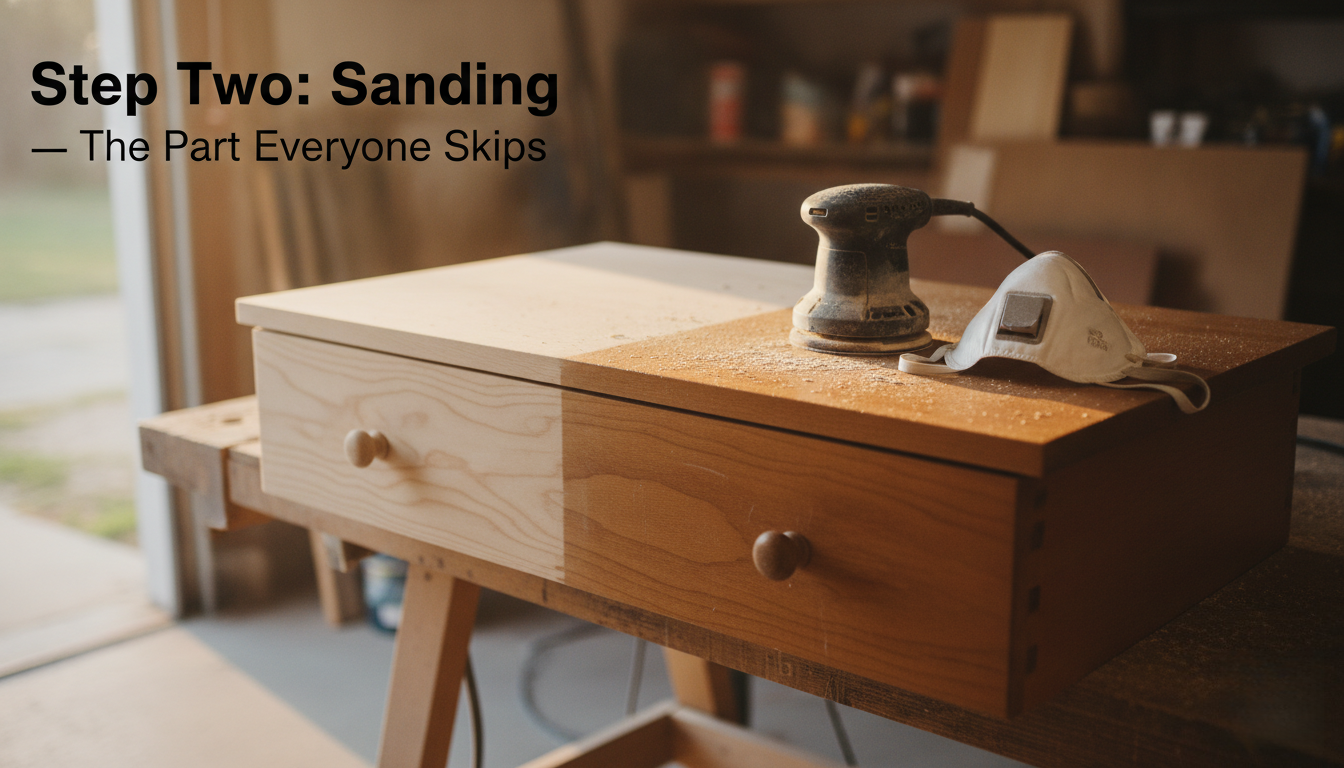
Total sanding time: just under three hours, spread across one Saturday morning. I wore a mask. I wore safety glasses. Mia came into the garage exactly once, announced "it's dusty," and left.
When the old stain was fully stripped and the wood was pale and even, I wiped everything down with a tack cloth to remove the dust. Skipping the tack cloth step is how you end up with little grit bumps in your finish. I've done it. I've regretted it.
Step Three: The Stain Choice I Almost Second-Guessed
I wanted a finish that looked like the dresser had always been beautiful but had never been trying too hard. I went with a gel stain in a medium walnut — gel stains sit on top of the wood instead of penetrating deeply, which makes them more forgiving on pieces where the wood grain isn't perfectly even.
The near-mistake: I almost applied the stain without testing it on the back of one drawer first. I was tired. I was impatient. I wanted to see results. But I stopped myself, tested a small patch, and discovered the gel stain pulled slightly redder on this particular maple than I expected. I switched to a darker walnut shade that neutralized the red undertone.
Testing stain on an inconspicuous spot isn't optional. I've been doing furniture makeovers for years, and I still test every single time. The one time I don't will be the time I ruin a piece.
I applied the stain with a clean rag, working in sections, wiping away the excess as I went. Two coats, three hours of drying time between them. By Saturday evening, the garage smelled like stain and I felt like I'd accomplished something real.
Step Four: Hardware That Makes It Look Expensive
Remember the three mismatched knobs and one empty hole? I replaced all six drawer pulls with unlacquered brass cup pulls that matched the three original ones in shape but were intentionally new. The mix of old and new hardware feels collected, not chaotic.
Hardware is the easiest way to make a dresser makeover look high-end without spending high-end money. The new pulls cost $18 total from an online hardware supplier. Combined with the $40 dresser and $15 in sanding pads and stain, my all-in cost was $73. I already had the tack cloths and cleaning supplies.
The Reveal
The dresser now lives in our bedroom, holding sweaters and pajamas and one drawer that Mia has claimed for her sticker collection. It looks like a piece someone paid $400 for at an antique store — not because I'm talented, but because someone else didn't see what was under the orange stain.
Derek walked in while I was taking photos of it for this post and said, "That's the same dresser?"
That's the whole point.
A home is never finished. But this dresser is.
No feedback yet — submit the first.