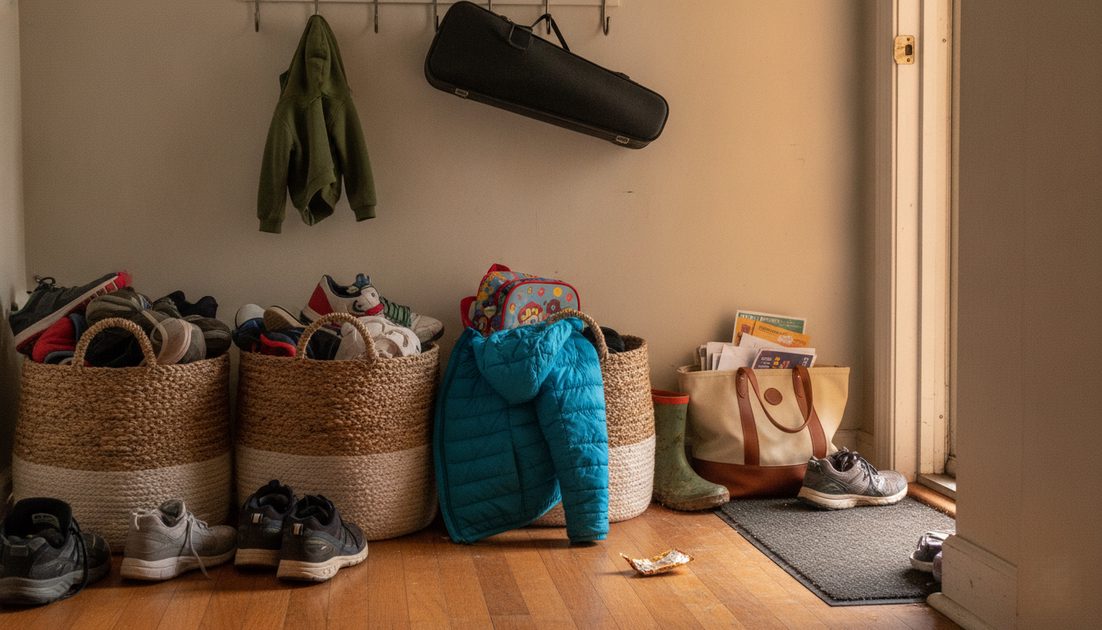
Our entryway is four feet wide.
That's it. Four feet from the front door to the living room. In that four-foot zone, the following things accumulate on a daily basis: three pairs of adult shoes, approximately seven pairs of tiny shoes that Mia has kicked off while running, Derek's trumpet case, my tote bag, Mia's backpack, a stroller we keep meaning to put in the garage, mail I haven't opened, mail I have opened but haven't thrown away, one lone mitten, and a granola bar wrapper.
I used to look at entryway photos on Pinterest. The ones with a single ceramic vase on a console table. A woven basket with one neatly folded throw blanket. A pair of tasteful boots arranged just so.
I don't look at those anymore. That entryway doesn't live with a four-year-old and a trumpet player. That entryway has never met a granola bar wrapper.
Here's the system I landed on after twelve failed attempts — and why a 60% success rate is actually a victory.
The Problem With Most Entryway Organizing Advice
Most entryway organization ideas are written for people with mudrooms. Or built-ins. Or a hall closet within arm's reach of the front door. I have none of those things. I have four feet of wall space, a door that swings inward, and a family that treats the floor as a perfectly acceptable storage surface.
I tried a shoe rack. It held three pairs of shoes. The other ten pairs formed a semicircle around it like a shoe rack protest.
I tried a wall-mounted mail organizer. Derek put his trumpet mouthpiece in it. I don't know why. Neither does he.
I tried a bench with storage cubbies. Mia used it as a stage for performances. The cubbies held exactly nothing because getting into them required lifting the bench lid, and nobody in my family lifts lids except me.
The problem wasn't the products. The problem was that I was designing a system for the family I wished I had, not the family I actually have.
The Real Drop Zone Audit
I spent one week doing nothing differently — no tidying the entryway, no reminders, no passive-aggressive shoe rearranging. I just watched what actually happened in those four square feet.
Here's what I learned:
Shoes came off the second people walked in. Not after they got to a bedroom. Not after they found a shoe rack. Immediately. At the door. This is good behavior, actually. The problem was the pile.
Mail landed wherever hands were free. Sometimes on the floor. Sometimes on top of the shoe pile. Once, memorably, inside Derek's trumpet case.
Mia dropped everything and kept moving. Backpack, coat, one shoe, the other shoe twelve feet later, a drawing from preschool, a rock she found.
Nobody ever hung anything up. Not coats. Not bags. Not scarves. The hooks I had installed at eye level went completely unused because hanging things requires two hands and an extra second, and everyone in my family is apparently in a race to exit the entryway as fast as humanly possible.
This audit changed everything about my approach to drop zone organizing. I stopped trying to change the behavior and started designing around it.
What Actually Worked: The Three-Basket System
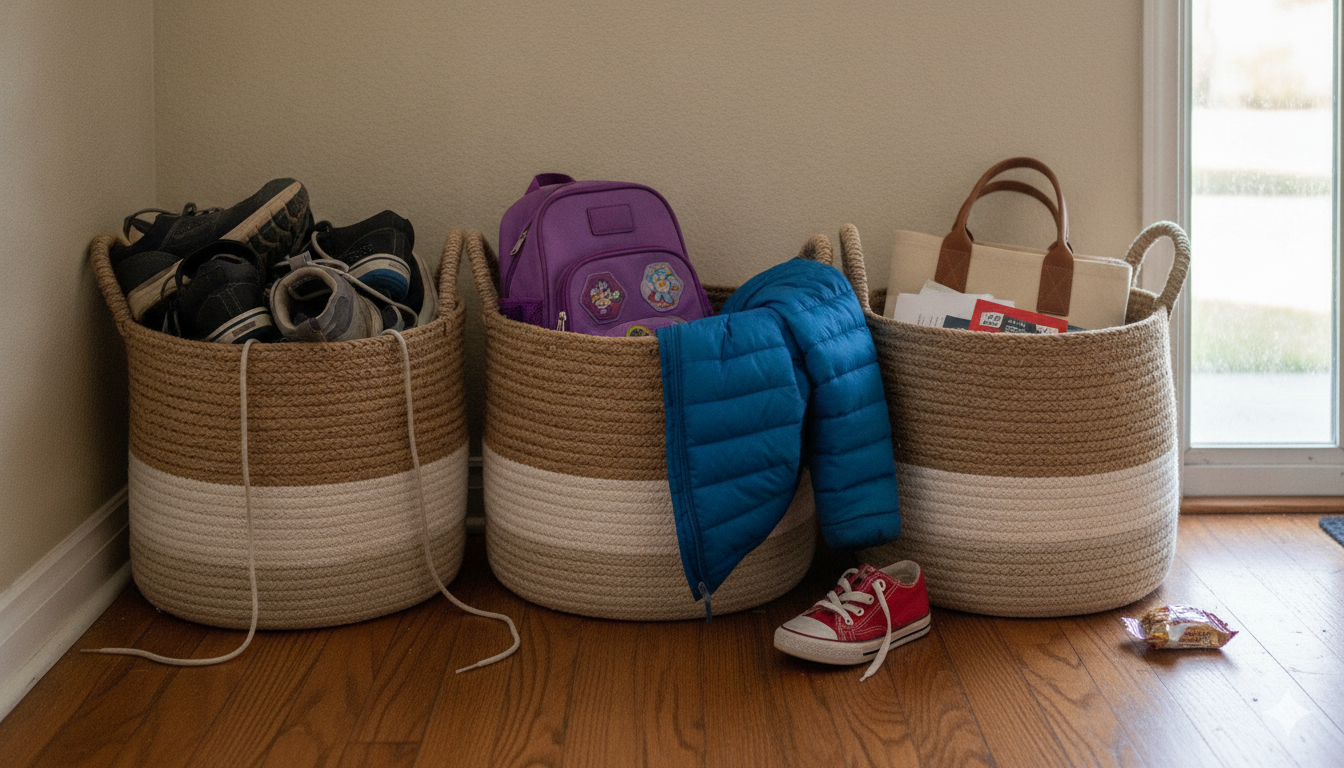
The system that finally stuck is embarrassingly simple. I bought three large baskets — the kind with handles, open tops, no lids — and lined them up against the wall where the shoe pile used to form.
Basket one is for shoes. Not organized by person. Not paired. Just contained. The rule is: shoes go in the basket. Not next to the basket. Not near the basket. In it. This rule is followed approximately 60% of the time, which means instead of seventeen shoes on the floor, there are usually six or seven. That's a 65% reduction in floor shoes. I'm calling it a win.
Basket two is for Mia. Backpack, coat, hat, drawings, rocks, the thing she made with pipe cleaners, whatever else she's carrying. The basket is large enough that she can drop things in without aiming, which is apparently critical for a four-year-old's compliance. She uses it about 70% of the time. The other 30%, the items remain on the floor directly next to the basket, which is so close to success that I've decided not to care.
Basket three is for Derek and me. My tote bag goes in it. His music folder goes in it. Mail goes in it until I deal with it. It's a contained chaos basket, and it has prevented more arguments than I can count.
Total cost of this system: $34 for three baskets from a home goods store. That's it. No installation. No labels. No complicated family meeting about new procedures. Just three baskets on the floor, absorbing the chaos.
The Hook Situation I Finally Got Right
Remember how nobody used the hooks I installed at eye level? I moved them.
I put four hooks at Mia height — about three feet off the ground — and suddenly she hangs up her own coat. Not because I asked. Because she can reach them. She's four. She wants to do things herself. The hooks had been at my height, not hers, and I had been solving for the wrong person.
I also installed two hooks at grab-and-go height for Derek's trumpet case and my reusable shopping bags. Not decorative hooks. Heavy-duty ones that can hold actual weight.
This was the missing piece of small entryway storage for our family: placement that matched the actual humans using it. Not the humans I imagined when I was designing the system.
What 60% Success Actually Looks Like
Here's what our entryway looks like on a typical day now:
The baskets are mostly doing their jobs. There are usually two to four shoes on the floor instead of seventeen. Mia's coat is on her hook about half the time — the other half it's on top of her basket, which I've decided counts. The mail is in the mail basket, unopened but contained. Derek's trumpet case is on its hook unless he's been practicing, in which case it's in the living room, which is a different problem for a different blog post.
Is it Pinterest? No. Is it functional? Yes, 60% of the time, which is roughly 60% more functional than it was before.
The remaining 40% is just life. Someone's in a rush. Someone's carrying a screaming child. Someone got home late and dropped everything and collapsed. I don't expect the system to work on those days. I expect it to be easy enough to reset in five minutes the next morning.
The Thing I Stopped Caring About
I used to think family mudroom solutions meant the entryway had to look good all the time. Now I think it means the entryway has to be easy to fix when it doesn't.
The baskets take sixty seconds to tidy. Pick up the straggler shoes. Toss them in. Done. I don't need a system that prevents mess. I need a system that makes mess easy to clean up.
That's the difference between organizing for photos and organizing for real life. In photos, everything is always in its place. In life, things land where they land, and you need a place that's close enough and easy enough that people hit it most of the time.
Sixty percent of the time works. The other forty percent, I shut the front door and stop looking at it.
A home is never finished. The entryway especially.
No feedback yet — submit the first.